

Scaling enterprise footprint with partners in MENA
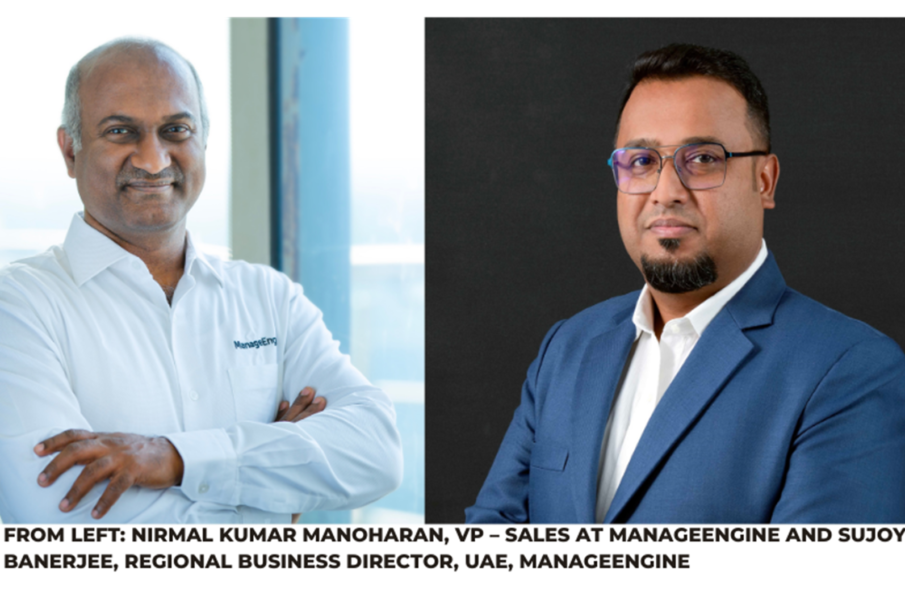
In this conversation with CXO DX, Nirmal Kumar Manoharan, VP – Sales at ManageEngine and Sujoy Banerjee, Regional Business Director, UAE, ManageEngine highlight how ecosystem collaboration, architectural guidance, and local presence enable the company to scale across the region’s enterprise customer environments.
How successful has ManageEngine been with the enterprise market and customers in the region?
Nirmal: We are very much a large enterprise player in the Middle East, and the perception is clear that we can serve large enterprises. Some of our large customers include entities managing transportation infrastructure in Dubai, Airports, airlines, and all major banks. The MENA region today contributes roughly 8% of our global revenue and is growing at an impressive rate. Saudi Arabia is our largest market in the region, followed by the UAE, and then Egypt. Despite economic downturns in 2022, revenue has grown 5–6x since then because we stayed engaged with customers and partners.
Sujoy: We can’t name specific entities, but one of ManageEngine’s biggest strengths is that we’re not restricted to a single vertical. We work across healthcare, education, oil and gas, and multiple government departments. In the UAE, government and public sector contribute a significant share, especially from Abu Dhabi, but we’re not limited to Abu Dhabi. We’re active across the Northern Emirates as well. For example, we hosted an invite-only IT seminar in Ajman with over 50 government customers. Government offices there are clustered closely, which helped penetration. That said, nothing is permanent. We usually start with a large organization and then expand into multiple entities under that umbrella. We’ve seen this approach work in Abu Dhabi and now in Ras Al Khaimah as well. The government sector remains a large chunk of our UAE growth.
Beyond the UAE and Saudi Arabia, how are other GCC markets performing from your perspective?
Nirmal: IT maturity is not uniform across the GCC, but that’s actually an opportunity. Even organizations with lower maturity can use our products. We’ve had engagement with GCC, North Africa, and African markets for over 10–15 years. In the last five years especially, these markets have grown significantly.
We always take a long-term approach. Benefits may not come immediately, but they come over time. In terms of revenue today, roughly, Saudi Arabia and the UAE make up one-third each of our regional revenue. The rest of the GCC and North Africa make up the balance one-third. It’s a very significant market for us.
Qatar is largely government-driven. We work through partners like QCS and Burhan Tech, which has strong traction in the region.
Oman has been with us for nearly 20 years; one of our earliest large customers came from there. We work with partners like Khimji Ramdas and others. While government dominates, private sector presence is also strong there. Bahrain is a mix of government and private.
Kuwait has strong private sector business, and government engagement is now picking up. Even Egypt contributes evenly. While markets may appear unequal, all have built strong IT capabilities over the last decade, and we are deeply engaged across them.
Part of this success comes from proximity to our India office. We’re only three to four hours away, compared to vendors traveling 15 hours from the US. We’ve had our experts traveling continuously for the last 20 years from India. Even today, we have people on the ground, and domain experts traveling from India where the technology know-how resides.
Sujoy: At any given point in a month, there are around 10 to 12 members in the UAE onlyfrom our product teams on the ground, engaging directly with customers. While partners play a critical role, this is not a model where we simply rely on partners and step back. We work in parallel with them. Our partners act as an extended arm of ManageEngine, handling on-ground engagement, opening doors, and driving conversations. At the same time, we provide active support across both pre-sales and post-sales engagements. Whether in the UAE or Saudi Arabia, where the geography itself is significant, there are always teams from our side travelling, meeting customers, and supporting large deployments. Partners are an extension of our team, not just resellers.
What led to the decision to own your own data centers in the region
Nirmal: We wanted tighter control, over bandwidth, infrastructure, and long-term operating costs. Once organizations are locked into third-party environments, costs tend to escalate over time, and eventually those increases are passed on to customers. No company can absorb those costs indefinitely.
That’s why, even 15 years ago, we made a conscious decision to invest in our own data centers with a long-term perspective. Owning our infrastructure gives us greater flexibility, cost predictability, and operational control, benefits that ultimately translate into better outcomes for our enterprise customers.
When it comes to partner engagement, how does the model work if a local partner has the customer relationship but lacks the required technical depth? How do you handle support and commercial responsibilities in such cases?
Nirmal: One important aspect of how we operate is that we actively facilitate collaboration within our partner ecosystem. As a vendor, we do have certain limitations in terms of how much time we can spend delivering services for a single customer. Our core focus remains on the product, and we typically avoid directly taking on services engagements.
At the same time, customers often want services and are willing to pay for them in order to extract full value from the product. That is where our partners play a critical role. While one partner may not have all the required capabilities, the partner community collectively has immense expertise. Partners frequently work together, bringing in specialists from other partners when needed. This kind of collaboration happens very often. In most cases, partners work these arrangements out among themselves as part of the ecosystem we have built. We don’t need to get involved in every instance, although we are always available when required.
For large deployments, especially at the architectural level, we do step in more actively. We have better visibility into long-term product direction and help customers design deployments that are scalable and future-ready, rather than taking a short-term approach. We may suggest alternative deployment architectures that can scale better over time.
When it comes to integrations or niche expertise that a partner may lack, they typically engage another partner or specialist developer. Over time, a strong ecosystem has developed where these collaborations are well understood and executed. Commercially, these collaborations are handled by the primary partner engaging the customer. They manage the commercial arrangements and bring in additional partners or resources as required.
What does your Middle East team look like today, and how are you expanding?
Nirmal: Currently, the Middle East team is about 15 people. Given post-pandemic growth, we plan to at least double the team by the end of this year.
We’re also engaging with universities and leveraging Zoho’s broader ecosystem to build our own talent pipeline, because partners don’t typically hire fresh graduates, and that’s important for long-term growth. This expansion is fully aligned with our overall vision.
In the earlier days of your operations in the region, you were meeting customers almost one-on-one. While that may not be as feasible today, how important have user conferences and similar initiatives become over the years in managing customer engagement at scale?
Nirmal: That’s correct. Earlier, meeting everyone personally was possible. Today, it’s not that easy or scalable. That’s where user conferences and education series come in.
User conferences are primarily educational initiatives. Beyond that, we also run domain-specific seminars and workshops, whether it’s ITSM or other areas. All of these are essentially education-focused, but they also allow us to interact with many customers at the same time.
Interaction happens at multiple levels. One is direct customer interaction; visiting their environments, understanding how they use the product, their challenges, and new requirements. But that has scalability limits. Product managers cannot visit every customer all the time. That’s why conferences and workshops become very important. They allow product managers and teams to interact with customers at scale, gather feedback, and also educate customers about new offerings.
How have you evolved the user conference format over the years?
Nirmal: The core objective hasn’t changed which is education and feedback. But we’ve used technology to make it more efficient.
For example, we use Zoho Backstage (Zoho’s event management solution) to manage many aspects of the event, including one-on-one meetings. Even badge printing is automated. A lot of technology is used behind the scenes that attendees may not even notice. This automation improves efficiency and customer experience. And branding, at the end of the day, is about experience. What customers experience is what branding truly is. That philosophy applies everywhere; product usage, websites, and customer interactions. We try to make everything very easy for customers.
Are you also running in-country editions?
Nirmal: Yes, absolutely. Saudi Arabia is a good example. Until around 2017, it wasn’t easy to do large events in Saudi with visa challenges, infrastructure limitations, and so on. But Saudi has built infrastructure at a tremendous scale over the last few years.
We started doing user conferences there last year. Even before that, we were conducting workshops with around 50 participants. Saudi is a massive country, so multiple such activities were needed. Now, with government incentives, strong infrastructure, and huge market potential, we’re doing larger events; LEAP, Black Hat, and others. The moment these possibilities opened up, we moved in.
Have you considered setting up a physical experience center for ManageEngine or Zoho?
Nirmal: Conceptually, it’s a good idea and could be considered. The challenge is that every user environment could be different. At the moment, we have been focusing on participating in major trade events across the region.
Sujoy: We are present at almost every major trade show and exhibition related to IT, security, service management, AI etc. While we don’t have one AI product, we have AI in everything. That aligns well with events like GITEX, where AI in everything is a key theme. These platforms allow customers to see demos, features, and roadmaps. UAE is one of the regions where we invest heavily in trade shows and exhibitions.



Leave a reply