
Building Success on Expertise, Trust, and Conviction
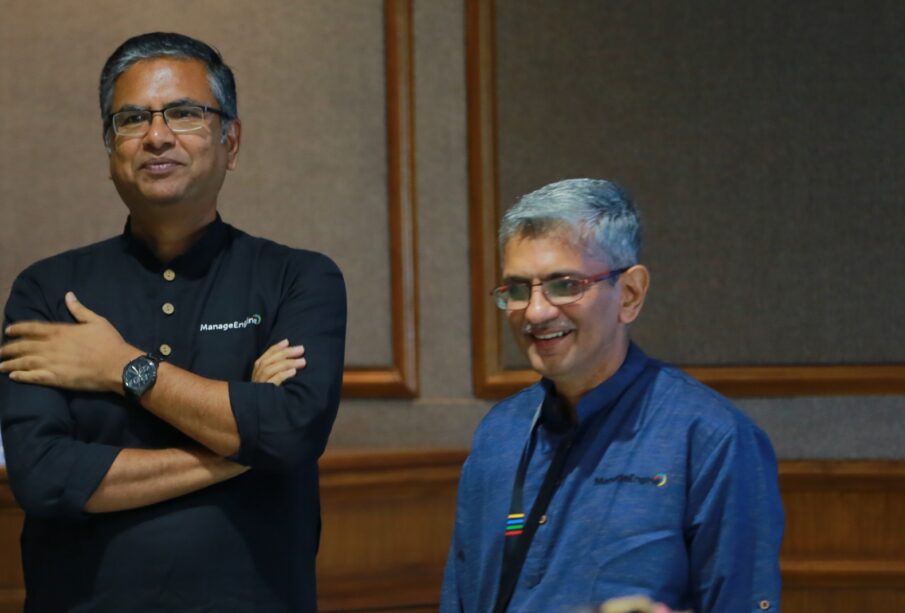
From left: Rajesh Ganesan, CEO of ManageEngine, and Sailesh Davey, Co-Founder & CEO of Zoho Corp, interacting with the media.
Over the three decades of its existence, Zoho Corp. has followed a trajectory shaped by core beliefs around building engineering depth, serving customer needs, earning their trust, and maintaining a long-term view. This philosophy has guided the company’s evolution, including that of its enterprise IT division, ManageEngine, anchoring growth in intent and longer-term objectives.
On the sidelines of its recent annual partner meet at its headquarters in Estancia IT Park, Guduvanchery near Chennai, ManageEngine’s leadership held focused interactions with visiting media representatives. These conversations offered rich insight into how the company has carved out a distinctive position in the technology industry, pivoted around enduring commitments to customers and society, long-term thinking, and a strong engineering focus.
In their respective keynote sessions and subsequent discussions, Sailesh, Co-Founder & CEO of Zoho Corp., and Rajesh Ganesan, CEO of ManageEngine, outlined how Zoho Corp and its enterprise IT division, ManageEngine, are evolving, while holding firm to the principles that have guided the company for three decades.
The journey so far
The dot-com crash of 2001 was an unexpected inflection point for Zoho that led to the eventual emergence of ManageEngine. As the telecom sector collapsed, many of the enterprise customers the company then served had disappeared almost overnight. It was a phase of disruption in the technology industry. In response, the company leadership adopted a more ambitious outlook and identified a more sustainable opportunity to provide reliable, accessible software for managing IT infrastructure in small and mid-sized businesses.
Rajesh says “Even in the early 2000s, the answer was clear that there were tens of thousands of businesses with this need. That was the birth moment for ManageEngine. We decided to pivot and diversify risk. This was our opportunity to go truly global.”
OpManager’s launch in 2003 as a downloadable product from the web, designed to solve a simple but mission-critical problem of keeping business systems running, was a watershed moment in the company’s journey.
“In 2003, we launched OpManager, a product you could download directly from the web and install on Windows NT, Windows 95, or Windows 2000 systems. It addressed a very simple but critical problem for businesses at the time, making sure their networks and systems were always running, so their operations would not go down. That was the founding idea behind ManageEngine.”
In the next few years, as cloud and mobile technologies transformed how enterprises operated their Businesses, ManageEngine scaled up its product offerings, helping businesses adopt technology with confidence to run their operations. Since then, the company has steadily built its growth story, evolving and reinventing through the years, and at all times guided by customer needs and a long-term view of the business.
As Sailesh remarks, “This is not something that happened overnight. It’s a 30-year journey”.
Evidence of Zoho’s visionary outlook lies in the fact that the company began offering cloud services as early as 2006, ahead of the rise of hyperscalers. This was a deliberate decision to run its own data centers and build in-house infrastructure expertise, and as Sailesh explains, this choice was never about owning infrastructure for its own sake, but about developing deep operational knowledge that could ultimately benefit customers.
“At the end of the day, what we sell is our skills and our knowledge,” he notes. “If we build expertise, whether in software or running data centers, we can pass that value on to the customer.”
Today, Zoho operates its own data centers and a global footprint of around 30 offices across regions including Egypt, Saudi Arabia, Thailand, and Singapore, among others.
“When we open offices, we hire locally, train locally, and build teams that do the last mile for customers. Growth is important, but contributing back to the local economy is just as important,” adds Sailesh.
Transnational Localism
Zoho follows a distinctive expansion model, which the company refers to as transnational localism, by building offices in second and third-tier cities. The company stays invested in local economies by hiring locally and training them.
Sailesh explains, “Instead of forcing talent to move to cities, we go where the talent is, to the tier-three and tier-four towns and build offices there.”
The same approach extends globally, whether in the US, Mexico, or elsewhere.
Building the speedboats
Since its beginning, ManageEngine adopted a defining strategy of building many focused products rather than a single monolithic solution. This philosophy is based on building “a thousand speedboats” rather than one large ship, which resulted in the multitude of enterprise-focused products that it has built.
Whether serving IT departments through ManageEngine or supporting broader business functions, the company focused on solving the full spectrum of operational challenges, from network connectivity and cloud services to vendor coordination and supply chain workflows.
Sailesh explains that Zoho’s core strength lies not in the type of problem solved, but in using technology effectively to solve problems, regardless of domain.
As of today, ManageEngine offers close to 60 products supporting multiple IT functions, and as a privately held company, the group has fuelled its growth through its own earnings. Staying away from external funding has allowed the company the freedom to maintain control, stability, and a long-term focus.
From Monitoring to Security
ManageEngine’s trajectory mirrors Zoho Corp’s broader philosophy, which is about building depth before breadth and pursuing evolution without abandonment.
“Over the last 20 years, we’ve been known for different things at different times. We started as a monitoring company, then we were known as a service management company, later for Active Directory services, and now endpoint management,” says Sailesh.
Security has become a core focus for the company in recent years.
“There is a strong focus on security today, and there will be many announcements around new security products. I believe by 2027, people will look at ManageEngine as a security company as well,” he adds.
This shift does not come at the cost of other areas of strength for the company where it equally continues to invest and strengthen its solutions offerings.
“We believe in being a one-stop shop for IT monitoring, service management, endpoint, server management, analytics, and security. All of these have been built over two decades and continue to evolve,” he adds.
Building Depth
While ManageEngine follows a unified platform approach across its product portfolio, it ensures that each product continues to evolve with feature enhancements at every refresh, whether it is ServiceDesk Plus (ITSM), Endpoint Central (unified endpoint management), OpManager (network monitoring), and AD360 (Active Directory management), or any other solution in its lineup. A key advantage underpinning this approach is the fact that, unlike in many organizations where expertise is lost as employees move on, ManageEngine has teams that have been working on the same problem spaces for a decade or more. This continuity, Sailesh explains, enables ManageEngine product teams to build deep, sustained expertise within specific product domains and to retain critical domain knowledge over long periods.
“All our products are built on the same platform, which makes integration easy. But equally important is our people. We have one of the lowest attrition rates in the industry. Many have been working on the same domain for 10 years, 15 years, and so they are able to react faster to the needs of the customer and market shifts,” adds Sailesh.
Privacy by Design in the age of AI
One of the strongest and most consistent messages across sessions was Zoho’s emphasis on data privacy, particularly as AI adoption accelerates.
“Whether it’s Zoho or ManageEngine, our approach to data privacy is the same. Customer data belongs 100 percent to the customer. We do not use it, we do not show ads, and we enforce this through processes,” says Sailesh.
In the context of AI, this principle becomes even more critical.
“We do not use customer data to train our AI models. We use synthetic data or data procured externally. If customers want to train models using their own data, they can do so and deploy those models themselves,” he adds.
Zoho has built this capability directly into its products.
“We’ve made it easy through the user interface. Customers can train, deploy, and manage their own models. We monitor model drift and retrain automatically, but all of this happens without us looking at customer data,” adds Sailesh.
Rajesh reinforces this point.
“We do analyze anonymized usage patterns to improve products,” he adds. “But we never access identifiable customer data, and it never goes to third parties. Monetizing data is simply not our business model.”
AI sans the hype
Zoho Corp takes a more pragmatic view of Generative AI. For over a decade and more, the company has focused on using and leveraging AI where it looks relevant and not just for the sake of it.
“AI didn’t start with generative AI. We’ve been using classical machine learning and deep learning for over a decade where it made sense,” says Sailesh.
Today, Zoho uses both traditional AI techniques and generative models selectively.
“Not every problem needs generative AI,” he said. “Based on the problem, we use the right technique without falling for the hype.”
On the LLM front, the company follows a pragmatic approach to offer solutions that address productivity objectives for Businesses.
Raesh says, “We focus on right-sized models that work with three to seven billion parameters today, and work is underway on larger models like 32 billion. These are tuned for specific business contexts and low-risk decisions. We’re not trying to compete with foundational models. We fine-tune models to deliver meaningful productivity gains, between 40 to 60 percent, which is still significant.”
Looking ahead, agentic AI is a key area of focus for the company.
“Agents can reason, use tools, and self-help,” says Sailesh. “We believe technology is at an inflection point, and we are investing heavily to understand where AI genuinely solves customer problems.”
Cloud-Native, Sovereign-Ready
Regarding sovereign cloud and private deployments, the company draws a clear distinction between infrastructure providers and application platforms.
“We are not competing with hyperscalers in IaaS or PaaS. But we fully comply with data residency laws wherever we operate,” says Sailesh.
For governments and regulated enterprises, Zoho supports private and air-gapped deployments.
“Most of our applications are cloud-native, but we do deploy them in private cloud environments when required,” he adds.
The Roadmap Ahead
As Zoho and ManageEngine look forward, the priorities are clear.
“Our roadmap has three focus areas: AI, security, and platform,” Sailesh said. “Enterprises don’t want isolated point products. They want customization, process modelling, and deep integration.”
Sharing his perspective, Rajesh says, “We’re not here to chase trends. We’re here to build resilient systems, protect trust, and stay relevant for decades, not quarters.”
Zoho’s leadership is driven by the belief that trust, patience, and engineering depth are not constraints but advantages.
As Sailesh reiterates, “We are in this for the long term. That freedom allows us to do what is right for the customer, and that has made all the difference.”



Leave a reply